At a glance
| Dates | Expected Nov/Dec/Jan/Feb 2026–27Not announced as of 18 October 2026. Recent lightings were 18 Dec 2022, 8 Dec 2023, 15 Nov 2024 and 5 Dec 2025, each running into late January or February (the last two for 80 days). Expect the lights to go on between mid-November and mid-December 2026 and stay up into February 2027, probably past the Seollal holiday (6–9 Feb 2027). For the last three editions the first press reports of Jung-gu's announcement appeared 2–11 days before the lighting (27 Nov 2023, 13 Nov 2024, 28 Nov 2025). |
|---|---|
| Next edition | 2026: Not announced as of 18 October 2026. Recent lightings were 18 Dec 2022, 8 Dec 2023, 15 Nov 2024 and 5 Dec 2025, each running into late January or February (the last two for 80 days). Expect the lights to go on between mid-November and mid-December 2026 and stay up into February 2027, probably past the Seollal holiday (6–9 Feb 2027). For the last three editions the first press reports of Jung-gu's announcement appeared 2–11 days before the lighting (27 Nov 2023, 13 Nov 2024, 28 Nov 2025). |
| Weather | November average 17/8 °C (62/47 °F), 50 mm of rain December average 10/2 °C (51/36 °F), 34 mm of rain January average 8/0 °C (47/32 °F), 35 mm of rain February average 10/2 °C (50/35 °F), 50 mm of rainNear or below freezing after dark: a warm coat and layers. Monthly averages, not a forecast: Korea Meteorological Administration climate normals, 1991–2020, Busan station. |
| Admission | Free. The lights, main tree and stage programmes are open to everyone; a few hands-on workshops need advance booking. |
| Venue | Gwangbok-ro and Gwangbok Jungang-ro (main tree at Gwangbok-ro City Spot)부산광역시 중구 광복로 72-1 (광복동2가) |
| Nearest station | Nampo Station (남포역), Busan Metro Line 1, Exit 7Gwangbok-ro begins near Exit 7; about 5 minutes on foot into the lit street |
| From Seoul | about 2 h 35 min · KTX + SubwayLeave from Seoul Station · One-way fare from ₩54,400Full route · Festivals by travel time from Seoul |
| Organizer | Jung-gu Office, Busan부산광역시 중구청 |
| Usual timing | Lit every evening for about 80 days from mid-November or early December into February, usually past the Lunar New Year holiday: 18 Dec 2022–29 Jan 2023, 8 Dec 2023–12 Feb 2024 (extended twice), 15 Nov 2024–2 Feb 2025, 5 Dec 2025–22 Feb 2026. Jung-gu announces the dates only days before the lighting. Browse November / December / January / February festivals. |
| First held | 2009 |
| Last checked | 21 October 2026Checked against 40 sources · See sources |
What it is like
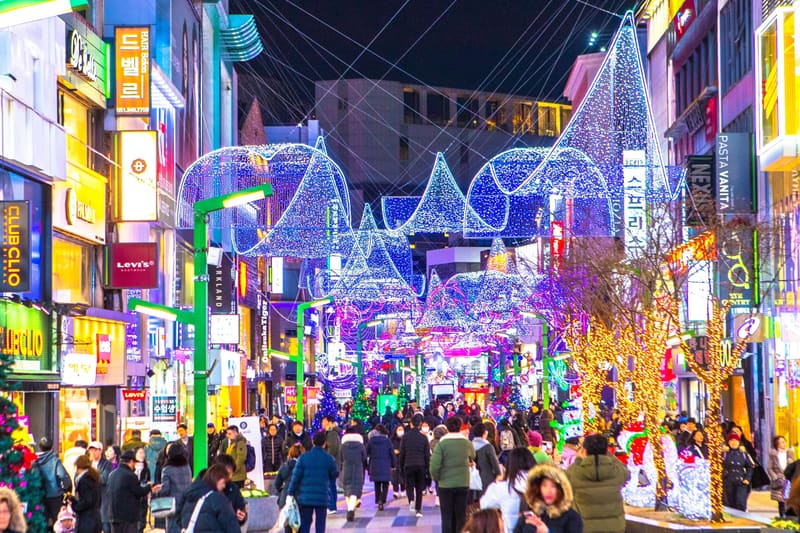
Gwangbok-ro is the main shopping street of Busan's old downtown, starting near Nampo Station and running towards Gukje Market below Yongdusan Park. Every winter since 2009 the Jung-gu district office has strung it with lights. The event began as the Busan Christmas Tree Culture Festival (부산크리스마스트리문화축제), partly to help struggling neighbours and to bring shoppers back to a fading city centre. Busan city has listed it as the Gwangbok-ro Winter Light Tree Festival since at least 2022.
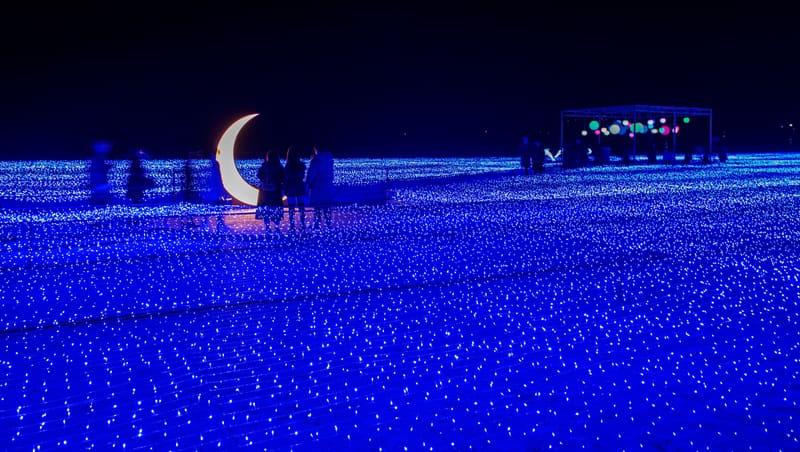
The format barely changes. About 1.1 km of Gwangbok-ro and the neighbouring Gwangbok Jungang-ro are lit every evening for roughly 80 days, with a large main tree at City Spot on Gwangbok-ro. Each year has its own theme. In 2023 it was "Shining Heritage 345", the district's history told in light, with a tree that changed colour when touched. 2024's "Gwangbok Light: Masterpiece" brought in a media tree that plays anamorphic (3D-effect) video. The tree came back in 2025 under the K-culture theme "K-Nuri: From Gwangbok to the World", along with sculptures of a tiger, a magpie and the royal Sun, Moon and Five Peaks screen, plus a light fountain and an interactive media façade.
The programme is small: a countdown lighting ceremony on opening night, busking and choir concerts on December weekends, a few bookable Christmas workshops, costumed characters, and a monthly ceremony at which residents switch the tree on. A separate light trail, the Sanbok Sky Light Street, runs along the hillside road above the port.
There is no ticket and no gate, so the lights fit easily into an evening in Nampo-dong. Gukje Market, BIFF Square, Jagalchi Market and Yongdusan Park are all a short walk away.
The honest caveats: this is a decorated shopping district, not a designed light park, so expect shop fronts, street stalls and crowds around the trees. December weekends and Christmas are very busy: Jung-gu estimated about 3 million visitors for the 2023–24 edition and up to 50,000 a day over Christmas. Dates, theme and programme are usually announced only days before opening.
Highlights
- A media main tree at Gwangbok-ro City Spot playing anamorphic 3D-effect video (2024 and 2025), surrounded by light sculptures, a light fountain and an interactive media façade
- About 80 nights of lights on Busan's old-downtown shopping street, 17:30–22:00 in 2025 (18:00–22:00 in 2023 and 2024)
- Free to walk; the street starts near Nampo Station Exit 7 and leads to Gukje Market, with an escalator up to Yongdusan Park nearby
- Countdown lighting ceremony on opening night (Friday 5 December 2025, 17:30) and a monthly citizen lighting performance
- December weekend busking and concerts, community choirs, and Christmas workshops such as cooking classes and mini-tree making
- Companion Sanbok Sky Light Street on the hillside road above the port, from Hyegwang High School to the Yeongju-dong area
- Held since 2009, first as the Busan Christmas Tree Culture Festival; Jung-gu estimated about 3 million visitors for 2023–24
Who it suits. Best for couples, families and anyone in Busan between late November and February who wants a free evening walk combined with markets, street food and shopping in Nampo-dong; less suited to people who dislike dense crowds on December weekends, or who expect a staged light show rather than decorated shopping streets.
Getting there
From Seoul
KTX from Seoul Station to Busan Station, about 2 h 30 m (₩54,400 standard class on the fare table in force since the 1 September 2026 KTX–SRT merger; trains from Suseo also run to Busan as KTX). Then take Busan Metro Line 1 two stops south to Nampo Station and leave by Exit 7: Gwangbok-ro starts there, and the lights are about a 5-minute walk away.
From Busan
Busan Metro Line 1 to Nampo Station, Exit 7. From Busan Station it is two stops south; from Seomyeon stay on Line 1; from Haeundae or Gwangalli take Line 2 to Seomyeon and change to Line 1. Jagalchi Station is the next stop after Nampo (0.7 km) if you start at Jagalchi Market.
From Incheon Airport
Domestic flight from Incheon to Gimhae (Busan), then the Busan–Gimhae Light Rail three stops to Sasang, Metro Line 2 to Seomyeon and Line 1 to Nampo (about an hour from the airport to the city centre). The airport bus does not serve Nampo-dong: since July 2025 its Line 2 runs hourly to Seomyeon and Bujeon (adults ₩7,500, card only), where you change to Line 1. Or take AREX to Seoul Station and the KTX to Busan Station, then Line 1 two stops to Nampo.
Last leg from Nampo Station
Busan Metro Line 1, Exit 7. Gwangbok-ro begins near Exit 7; about 5 minutes on foot into the lit street
Getting home
The lights go off at 22:00. Busan Station is two stops from Nampo on Busan Metro Line 1, but the last KTX from Busan to Seoul under the timetable in force from 1 November 2026 was not checked, so whether you can get back the same night depends on it: check the last train in the Korail app (코레일+) or at Busan Station before your visit, and book the return in advance.
Parking
No parking on Gwangbok-ro itself (KTO). The Yongdusan Park car park charges ₩500 per 10 minutes or ₩15,000 a day (KTO); a travel site cites about ₩2,000–4,000 an hour at public lots near Yongdusan Park and Jagalchi Market. Weekend evenings are congested, so the metro is easier.
How to switch Naver Map and Kakao Map to English
Google Maps shows train, subway and bus routes in Korea but not walking or driving directions yet, so for the walk from the station Naver Map or Kakao Map is more reliable.
Before you go
1330 · Travel hotline
The Korea Tourism Organization’s helpline answers in English, Japanese and Chinese around the clock, and in several other languages from 08:00 to 19:00. Dial 1330 from a Korean phone, or +82-2-1330 from a phone registered abroad.
112 / 119 · Emergencies
112 for police, 119 for fire and ambulance. Both are free from any phone. Police on 112 can add an English or Chinese interpreter to the call.
T-money card
Buy one at a convenience store such as GS25, CU or 7-Eleven and top it up there with cash. It pays for subways and buses in most cities, and for most taxis.
Maps
Use Naver Map or Kakao Map for walking and bus directions; Google Maps does not yet give walking directions in Korea. Both apps can be switched to English. Naver Map: Menu (≡) → Settings → Language (Japanese and Chinese also available). Kakao Map: Menu (≡) → Settings → App settings → Language. If the option is missing, change your phone’s language and reopen the app. Small shop names and some reviews stay in Korean.
Trains and buses
Book trains on Korail’s English site and express buses on Kobus. Holiday weekends sell out first.
Checked 18 October 2026.
Tickets, prices and practical details
| Item | Price | Note |
|---|---|---|
| Entry | — | Free in 2025; no change announced |
- Booking
- No booking is needed to see the lights. In 2025 the Christmas cooking class and mini-tree making (20–21 Dec) were booked in advance, and the monthly citizen lighting performance took applications through the festival's link page (litt.ly/gwangbok_treefestival); announcements go out on Instagram (@gwangbok_treefestival). Bookings for 2026 have not opened.
- English on site
- Busan city lists the festival in English on its events calendar; no English-language programmes or on-site interpretation were documented. Jung-gu Tourist Information Center: 051-254-5504.
- Crowds
- Very busy on December weekends and around Christmas: Jung-gu estimated about 3 million visitors for the 2023–24 edition and up to 50,000 a day over the Christmas holiday, when crowd-safety text alerts were sent. Busan Ilbo cites 2.38 million for 2022–23 and 2.9 million for 2023–24.
- Best time to go
- A weekday evening around sunset, when the lights come on (17:30 in 2025), or later in the evening; avoid Christmas Eve and December Saturday nights if you dislike crowds. The lights stay on until 22:00 through February.
- What to bring
- A warm coat, gloves and a phone power bank; December–February evenings are cold, and you will be walking and standing outdoors.
- Toilets
- KTO counts 113 public restrooms around Yongdusan Park and the traditional markets of the Yongdusan–Jagalchi special tourist zone.
Editions
| Year | Dates | Status | Notes |
|---|---|---|---|
| 2026 | Not announced as of 18 October 2026. Recent lightings were 18 Dec 2022, 8 Dec 2023, 15 Nov 2024 and 5 Dec 2025, each running into late January or February (the last two for 80 days). Expect the lights to go on between mid-November and mid-December 2026 and stay up into February 2027, probably past the Seollal holiday (6–9 Feb 2027). For the last three editions the first press reports of Jung-gu's announcement appeared 2–11 days before the lighting (27 Nov 2023, 13 Nov 2024, 28 Nov 2025). | expected | No 2026 theme, programme or contractor announcement found. Check the festival's Instagram (@gwangbok_treefestival) or Jung-gu (051-714-4758) from November. |
| 2025 | 5 Dec – 22 Feb 2026 | ended | Gwangbok-ro and Gwangbok Jungang-ro; one travel site describes about 2 km of lit streets in all. |
| 2024 | 15 Nov – 2 Feb 2025 | ended | About 1.1 km of Gwangbok-ro, extending into parts of Donggwang-dong and Bupyeong-dong. |
| 2023 | 8 Dec – 12 Feb 2024 | ended | Planned to 14 Jan 2024, extended to 31 Jan, then to 12 Feb at local merchants' request so the lights covered Seollal. Budget ₩700 million; Jung-gu estimated about 3 million visitors (2 million the year before) and up to 50,000 a day over Christmas, when crowd-safety text alerts were sent. |
Before or after the festival
Places you can fit in before or after the festival without missing the shuttle or the last train or bus back.
- Gukje Market (국제시장)Before
A market that grew out of an open-air trading ground after 1945 and boomed with Korean War refugees, now a maze of alleys of second-hand clothes, cosmetics, accessories and food across 12 buildings. Stalls keep 09:00–20:00 and close on Sundays (KTO; individual shops vary), so come on a weekday or Saturday before the lights go on or just after. Tip: the second-floor skybridges between its buildings help you keep your bearings.
Getting there: At the far end of Gwangbok-ro, on foot; the street ends at the entrance to its food alley
Busan's best-known seafood market on the harbour front, with fresh-fish stalls and grilled-fish and raw-fish restaurants. It runs 05:00–22:00 (closed on the first, third and fifth Tuesdays of the month), so have an early dinner here before the lights come on at dusk. Tip: walk from the market up through BIFF Square, the old cinema district where the Busan International Film Festival began in 1996, to reach Gwangbok-ro.
Getting there: About 5 minutes on foot from BIFF Square; or Metro Line 1 one stop from Nampo to Jagalchi
A hilltop park above Nampo-dong with the 120 m Busan Tower, whose observation deck looks over Busan Port, Gwangan Bridge and the lit streets below. The park is open at all hours and free; the tower runs 10:00–22:00 (last tickets 21:30; adults ₩12,000, children and seniors 65+ ₩9,000, per KTO), so it fits before or after the lights, which go off at 22:00. Tip: take the escalator up from Nampo-dong rather than climbing.
Getting there: Escalator up from Nampo-dong, about 10 minutes from the festival street; park free, tower ticket extra
- Bupyeong Kkangtong Night Market (부평깡통야시장)After
A night market of about 30 stalls inside Bupyeong Kkangtong Market, cooking traditional dishes from around the world and selling handicrafts from abroad. It runs 19:30–23:30 every day (local listing), so it is the one place here still open after the lights go off at 22:00; keep an eye on the time if you are catching the metro or the last KTX. Tip: most of the market's day shops close around 20:00, so the night stalls are the reason to come late.
Getting there: On foot past Gukje Market from the end of Gwangbok-ro; about 5 minutes from BIFF Square
Questions travelers ask
When is the Gwangbok-ro Winter Light Tree Festival 2026?
Not announced as of 18 October 2026. Recent editions lit up on 15 November 2024 and 5 December 2025 and ran about 80 days, so expect a start between mid-November and mid-December 2026 and lights into February 2027. Jung-gu usually announces the dates only a few days before the lighting.
Is the Busan Christmas tree festival on Gwangbok-ro free?
Yes. It is a street display with no ticket or gate; the 2025 edition was listed as free. Only a few workshops, such as the Christmas cooking class, needed advance booking.
What time are the lights on?
17:30–22:00 every day in the 2025–26 edition; 18:00–22:00 in 2023–24 and 2024–25. The opening-night countdown ceremony starts at 17:30.
Is this the same as the Busan Christmas Tree Festival?
Yes. Jung-gu has lit Gwangbok-ro every winter since 2009, first as the Busan Christmas Tree Culture Festival (부산크리스마스트리문화축제). Busan city still used "Busan Christmas Tree Festival" for the 2019–20 edition and has used "Gwangbok-ro Winter Light Tree Festival" since 2022.
Which subway station and exit should I use?
Nampo Station on Busan Metro Line 1, Exit 7, where Gwangbok-ro begins; the lights are about a 5-minute walk away. From Busan Station (KTX) it is two stops on Line 1.
How do I get there from Gimhae Airport?
Take the Busan–Gimhae Light Rail three stops to Sasang, Metro Line 2 to Seomyeon and Line 1 to Nampo, about an hour in all. The airport bus does not go to Nampo-dong; its Line 2 runs hourly to Seomyeon (adults ₩7,500, card only), where you change to Line 1.
Can I see it on a day trip from Seoul?
Possibly. The KTX takes about 2 h 30 m (₩54,400 standard class), but the lights come on only in the evening, so a same-night return depends on the last train back: check it in the Korail app (코레일+) for your date before you go, and book the return in advance.
What is the weather like during Gwangbok-ro Winter Light Tree Festival?
November in Busan: average high 17 °C (62 °F), low 8 °C (47 °F), 50 mm of rain (Busan station, KMA 1991–2020 normals). December in Busan: average high 10 °C (51 °F), low 2 °C (36 °F), 34 mm of rain (Busan station, KMA 1991–2020 normals). January in Busan: average high 8 °C (47 °F), low 0 °C (32 °F), 35 mm of rain (Busan station, KMA 1991–2020 normals). February in Busan: average high 10 °C (50 °F), low 2 °C (35 °F), 50 mm of rain (Busan station, KMA 1991–2020 normals). Near or below freezing after dark: a warm coat and layers.
Sources and verification
Facts checked
21 October 2026, against the sources listed below.
This page is desk research from the sources below, not a firsthand report of the 2026 edition. Confidence in the current facts: medium.
- Busan Metropolitan City — Calendar of Events: Gwangbok-ro Winter Light Tree Festival (2025)municipal — Official English and Korean name, 5 Dec 2025–22 Feb 2026, lighting 17:30–22:00, Gwangbok-ro and Gwangbok Jungang-ro, organizer Jung-gu Office, contact (051)600-4085
- Busan Metropolitan City — news: 2025 Gwangbok-ro Winter Light Tree Festival (17 Dec 2025)municipal — 2025 dates, K-culture overhead installations, weekend performances and hands-on programmes, photo zones, new media pole at the Gwangbok-ro entrance, main tree with dynamic lighting
- Busan Metropolitan City — Calendar of Events: 2023 Gwangbok-ro Winter Light Tree Festivalmunicipal — 2023 edition 8 Dec 2023–12 Feb 2024, lighting 18:00–22:00
- Busan Metropolitan City — Calendar of Events: 2022 Gwangbok-ro Winter Light Tree Festivalmunicipal — English name in use for 2022; 18 Dec 2022–29 Jan 2023, lighting 18:00–22:00
- Busan Metropolitan City — Calendar of Events: Busan Christmas Tree Festival (2019–20)municipal — Former English name for the 2019–20 edition (16 Nov 2019–5 Jan 2020) around Gwangbok-ro
- Busan Metropolitan City — news: 9th Busan Christmas Tree Festival (7 Dec 2017)municipal — 9th edition in 2017 (so first held 2009); free; Gwangbok-ro begins near Nampo Station Exit 7 on Line 1
- Korea Tourism Organization — festival listing: 광복로 겨울빛 트리축제kto — 2025 dates (marked ended), free, address 광복로 72-1, Jung-gu Office, phone 051-714-4758, homepage and Instagram, programmes: 5 Dec lighting, concerts, 20–21 Dec cooking class, mini-tree making and costume event, monthly citizen lighting
- KTO tourist data — 광복로 겨울빛 트리축제 (ktriptips mirror)kto — Hours 17:30–22:00, coordinates 35.0986/129.0327, host Jung-gu Office, free
- Official festival link page — 2025광복로 겨울빛 트리축제official — 2025 dates and 17:30–22:00, address, citizen lighting application form, festival Instagram @gwangbok_treefestival
- Kookje Shinmun — 2025 광복로 겨울빛 트리축제 개막 (28 Nov 2025)news — 80 days, theme K-누리 (광복에서 세계로), lighting Fri 5 Dec 17:30 at City Spot, anamorphic main tree returning from 2024, fountain plaza media, BNK Art Cinema programme, Sanbok-doro lighting 8 Dec 17:30 at Haneul-nun Observatory, Hyegwang High School to Yeongju-dong elevator
- Telltrip — 광복로 겨울빛 트리축제 guide (23 Dec 2025)blog — About 2 km of lit streets, free, 17:30–22:00, Nampo Exit 7 about 5 minutes on foot, tiger, magpie and Irworobongdo sculptures, December weekend busking, parking about ₩2,000–4,000 an hour, Yongdusan Park about 10 minutes, sunset visiting tip
- Nocut News — 2024 광복로 겨울빛 트리축제 개막 (15 Nov 2024)news — 2024 dates 15 Nov 2024–2 Feb 2025, theme 광복라이트 [명작], anamorphic and hologram main tree, Yongdusan Park sculptures, December concerts and busking, hillside-road lights over 2 km lit 18 Nov 17:30, monorail-platform media
- Busan Ilbo — 공실 늘어난 광복로… '트리 축제' 불빛으로 환해질까 (13 Nov 2024)news — 2024 edition 80 days to 2 Feb 2025 over about 1.1 km of Gwangbok-ro; festival began in 2009; visitors 2.38 million (2022) and 2.9 million (2023)
- haps Magazine via Stars and Stripes Korea — 2024 Gwangbok-ro Winter Light Tree Festival (13 Dec 2024)news — Lighting ceremony 15 Nov 17:30, lights 18:00–22:00, concerts 8, 15, 22 Dec and choirs 7, 14, 21 Dec 19:00–19:30, Santa and Rudolph 21–22 Dec 18:00–22:00, extends into Donggwang-dong and Bupyeong-dong, English theme 'Gwangbok Lights: Masterpiece'
- haps Magazine via Stars and Stripes Korea — Busan Gwangbok-ro Winter Light Tree Festival (3 Dec 2025)news — 2025 dates 5 Dec 2025–22 Feb 2026, English theme 'K-Nuri: From Gwangbok to the World', opening 17:30; gives lighting as 18:00–22:00 (conflicts with the official 17:30)
- Asia Economy (English) — Dongseo University designs Gwangbok-ro Tree Festival (4 Jan 2024)news — 2023 main tree 'Veil of Time 345' that changes colour when touched; designed with Dongseo University; says the festival ran from 2 December for 55 days (conflicts with the official 8 December)
- Insight — 부산 광복로 트리축제 (27 Nov 2023)news — 2023 planned dates 8 Dec–14 Jan, lighting 18:00–22:00, held since 2009, began to help neighbours and revive the downtown shopping district
- NS News (뉴스서울) — '샤이닝 헤리티지 345' 2023 광복로 겨울빛 트리축제 개막 (4 Dec 2023)news — 2023 theme and programmes, lighting ceremony 8 Dec at City Spot with Yonggol Dance Festa and Jagalchi song contest winners, ₩700 million budget, 1.6 km Sanbok light street from 13 Dec
- NS News (뉴스서울) — 2023 광복로 겨울빛 축제 점등 연장 (30 Jan 2024)news — Run of 55 days from 8 Dec to 31 Jan extended to 12 Feb for Seollal visitors at merchants' request
- Kookje Shinmun — 광복로 트리축제 연장 (31 Jan 2024)news — Extension to 12 Feb 2024, budget ₩700 million, about 3 million visitors (2 million the year before), up to 50,000 a day at Christmas, safety text alerts
- Jung-gu notice reposted on Welfare Hello — 광복로 겨울빛 트리축제 개최 안내 (2023)other — 2023 notice: 8 Dec 2023–14 Jan 2024, lighting 18:00–22:00 daily, Gwangbok-ro and Gwangbok Jungang-ro
- Seoul Shinmun — 광복로 1.2㎞ 수놓는 40만개의 빛 (27 Nov 2015)news — 7th 부산크리스마스트리문화축제 in 2015 (so first held 2009), Jung-gu with an organizing committee, 400,000 lights, 17 m tree, festival street 1,160 m
- KTO tourist data — 광복로문화패션거리 (ktriptips mirror)kto — Address 광복로 72-1; street runs from the Nonghyup Busan branch to the Gukje Market food-alley entrance; no parking; Jung-gu Tourist Information Center 051-254-5504
- itwiki — 남포역other — Nampo is station 111 on Line 1; neighbours Jagalchi (110, 0.7 km) and Jungang (112, 0.9 km); Exit 7 is on the Donggwang-dong side
- MileAsia — Busan Airport (Gimhae) to Busan Station 2026blog — Busan Station is station 113 on Line 1 (two stops from Nampo, 111)
- itwiki — 부산김해경전철other — Light rail order Sasang (01), Gwaebeop Renecite (02), Seobusan Yutongjigu (03), Airport (04): three stops from the airport to Sasang
- Wikivoyage — Gimhae International Airportother — Light rail and metro from the airport take about an hour to the city centre
- Busan Metropolitan City — Renovated airport bus operations commence on July 31 (2025)municipal — Airport bus Line 2 (Seomyeon·Bujeon) every 60 minutes, from the airport 07:00–22:00, adults ₩7,500, card or transit card only; Line 1 serves Haeundae·Gijang; no Nampo route
- KTO tourist data — 용두산공원 (ktriptips mirror)kto — Open at all hours, free, escalator to Nampo-dong, parking ₩500 per 10 minutes or ₩15,000 a day
- KTO tourist data — 부산타워 (ktriptips mirror)kto — Busan Tower (120 m): 10:00–22:00, ticket sales end 21:30, open all year; adults ₩12,000, children and seniors 65+ ₩9,000; views of Busan Port, Gwangan Bridge and Nampo-dong; modified 5 Aug 2026
- KTO tourist data — BIFF 광장 (ktriptips mirror)kto — Named when the first Busan International Film Festival opened in 1996; early handprint ceremonies; cinemas and shops
- KTO tourist data — 부산 자갈치시장 (ktriptips mirror)kto — 05:00–22:00, closed first, third and fifth Tuesdays; seafood, grilled fish and raw fish
- KTO tourist data — 국제시장 (ktriptips mirror)kto — Gukje Market: 09:00–20:00 (varies by shop), closed Sundays (varies by shop); grew from a post-1945 open-air market, refugees in the Korean War; alleys of second-hand clothes, cosmetics, food and accessories; 12 buildings with second-floor skybridges; modified 26 Oct 2026
- KTO tourist data — 용두산 자갈치 관광특구 (ktriptips mirror)kto — 113 public restrooms around Yongdusan Park and the traditional markets
- Travel Map Journey — 부산 남포동 당일치기 여행 가이드 (updated 25 Sep 2026)blog — Kkangtong Market to BIFF Square about 5 minutes on foot; BIFF Square to Jagalchi Market about 5 minutes
- Herald Business — 2027 calendar guidelines (29 Jun 2026)news — Seollal 2027 falls on Sunday 7 Feb; holiday 6–9 Feb including a substitute day
- Korail KTX fare table, effective 1 Sep 2026 (xls)official — Standard class Seoul–Busan ₩54,400 (₩54,000 via Seodaegu, ₩49,300 via Gupo); checked for the site's Busan Fireworks Festival record
- Hankyung — 9월 1일부터 서울~부산 KTX 5만4400원…운임 평균 10% 인하 (31 Aug 2026)news — KTX and SRT run as KTX from 1 Sep 2026; Seoul–Busan ₩59,800 to ₩54,400; former SRT trains from Suseo renamed KTX-Sancheon
- Busan → Seoul Station train timetable, 16–22 Oct 2026 (third-party mirror of the MOLIT/data.go.kr national timetable feed)other — Last trains 22:00 KTX 82 (arr 00:27) and 22:10 KTX 84 (arr 00:42), about 2 h 30 m; checked for the site's Busan Fireworks Festival record
- 여기유 (festival and travel listing) — 부평 깡통시장 야시장other — Bupyeong Kkangtong night market: about 30 stalls, world traditional food and overseas handicrafts; night market 19:30–23:30, open all year; general shops 08:00–20:00 (vary); 부평1길 48; 051-243-1128
What we could not confirm
- 2026 dates, theme, hours and programme had not been announced as of 18 October 2026; recent editions were announced only 2–11 days before the lighting, and the opening date has varied from 15 November to 18 December.
- Daily hours: 17:30–22:00 in 2025 per the organizer's link page, KTO and Busan city, but some English listings (Stars and Stripes) gave 18:00–22:00; 2023 and 2024 were 18:00–22:00.
- Edition count and name change: 2015 was the 7th and 2017 the 9th edition (first held 2009), but a 2023 article called it the 14th; whether 2020 and 2021 editions were held during COVID, and the exact year of the rename (between 2020 and 2022), were not verified.
- Length of the lit area: about 1.1 km (Busan Ilbo 2024), 1,160 m (2015), about 2 km including Gwangbok Jungang-ro (Telltrip 2025).
- Japanese and Chinese names: Busan city used 釜山クリスマスツリー文化祭り and 釜山聖誕樹文化慶典 for the former name; no official ja/zh name for the current festival was found.
- Visit Busan (visitbusan.net) and the Ministry of Culture festival page could not be read (blocked to automated fetching), and the web search budget ran out before 2026 news could be searched further.
- Last train back on the festival dates (December 2026–February 2027) from Busan Station to Seoul Station under the timetable in force that day; the fare (₩54,400) is from Korail's fare table effective 1 Sep 2026.
- Busan Metro Line 1 last trains from Nampo, the Line 1 ride time from Busan Station, and which Nampo exit is closest to the City Spot main tree were not checked.
- Accessibility, rain policy, pet rules and foreign-card acceptance were not published.
- Bupyeong Kkangtong night-market hours (19:30–23:30) come from a third-party listing; not checked against Jung-gu or the market. Gukje Market's Sunday closing is from KTO and varies by shop.
Changes: 2026-10-18 — Added to the site: fact-first record (dates, hours, prices, getting there, sources). · 2026-10-18 — Added a photograph from the Korea Tourism Organization (Korea Tourism Content Lab), KOGL Type 1. · 2026-10-21 — Transport: removed October-2026 last-train times (a new KTX timetable starts on 1 November, before the lights go on) and added a reminder to check the last train in the Korail app. · 2026-10-28 — Nearby rewritten as 'Before or after the festival' (shuttle and last-train fit); transport: no train, bus or shuttle clock times to remove (only the lights' hours), Korail+ last-train check kept; prices: unchanged (free entry; Busan Tower's standing admission from KTO)