At a glance
| Dates | Expected Apr/May 2027Buddha's Birthday is Thursday 13 May 2027 (KASI calendar; lunar 4/8). The parade has fallen on a Saturday four to nine days before Buddha's Birthday (11 May 2024, 26 April 2025, 16 May 2026), so expect the parade on Saturday 8 May 2027, the street festival on Sunday 9 May, and lantern exhibitions from late April to mid-May. The 2026 schedule was announced on 20 March. |
|---|---|
| Next edition | 2027: Buddha's Birthday is Thursday 13 May 2027 (KASI calendar; lunar 4/8). The parade has fallen on a Saturday four to nine days before Buddha's Birthday (11 May 2024, 26 April 2025, 16 May 2026), so expect the parade on Saturday 8 May 2027, the street festival on Sunday 9 May, and lantern exhibitions from late April to mid-May. The 2026 schedule was announced on 20 March. |
| Weather | April average 18/8 °C (64/46 °F), 73 mm of rain May average 24/14 °C (74/56 °F), 104 mm of rainMild days, cold evenings: a jacket for after dark. Monthly averages, not a forecast: Korea Meteorological Administration climate normals, 1991–2020, Seoul station. |
| Admission | Watching the parade, the lantern exhibitions and the street festival is free; some hands-on booths charge a small separate fee.Watching the parade, exhibitions and street festival: Free · Templestay, one day (1–31 May 2026, 35 temples): ₩15,000 · Templestay, two days one night: ₩30,000 (2026 prices) |
| Venue | Jogyesa Temple and Jongno (parade from Heunginjimun to Jogyesa)서울특별시 종로구 우정국로 55 |
| Nearest station | Jonggak Station (종각역), Seoul Subway Line 1, Exit 2300 m to Jogyesa; Anguk Station (Line 3) Exit 6 is also about 300 m |
| From Seoul | In Seoul · SubwayFull route |
| Organizer | Yeon Deung Hoe Preservation Committee (Jogye Order of Korean Buddhism)연등회보존위원회 (대한불교조계종) |
| Usual timing | Keyed to Buddha's Birthday (8th day of the 4th lunar month, which falls between late April and late May). The Seoul lantern parade is on a Saturday four to nine days before Buddha's Birthday, the street festival is the next day, and lantern exhibitions run for two to three weeks around them; the year's schedule is announced in March (20 March in 2026). Browse April / May festivals. |
| Last checked | 21 October 2026Checked against 17 sources · See sources |
What it is like
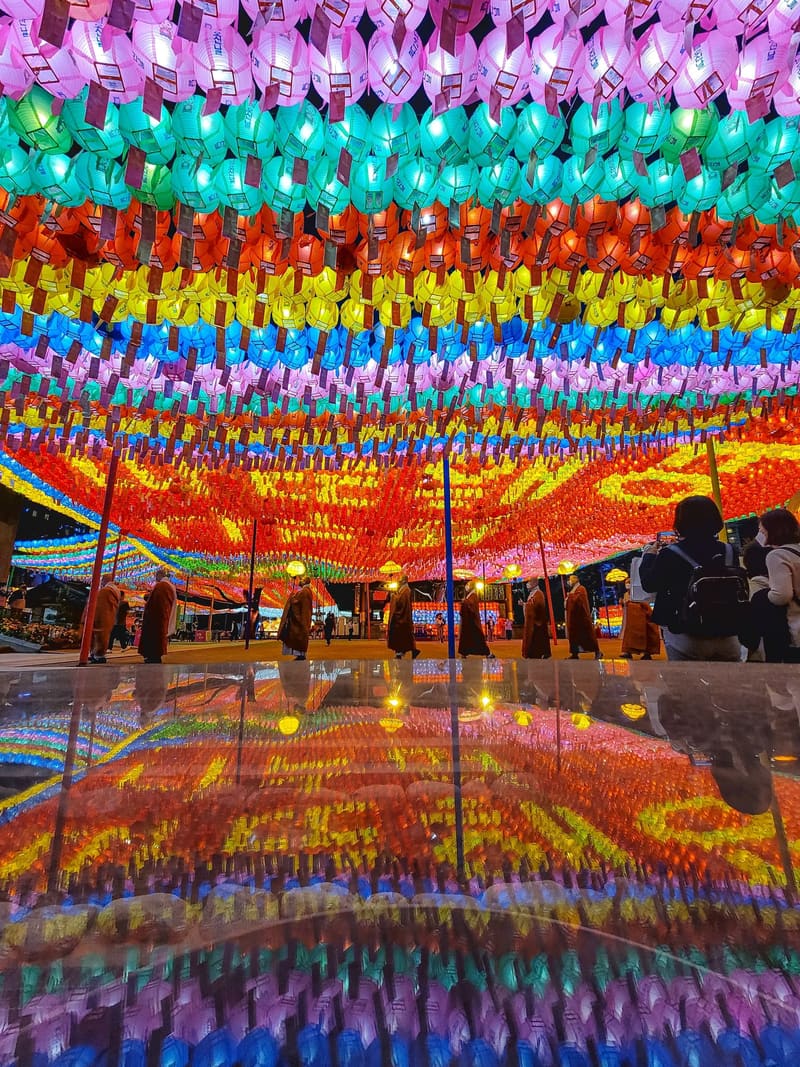
Yeon Deung Hoe is the lantern festival that Korean Buddhists hold in the weeks before Buddha's Birthday, organised in Seoul by the Jogye Order's Yeon Deung Hoe Preservation Committee. It was designated a national intangible cultural heritage in 2012 and inscribed on UNESCO's list in 2020. The festival unfolds in stages: a lantern-lighting ceremony in Gwanghwamun Square about a month ahead, exhibitions of traditional hanji-paper lanterns strung along Cheonggyecheon stream and in the grounds of Jogyesa and Bongeunsa temples, and then one weekend of street events. On the Saturday, a Buddhist rally (Eoulim Madang) with a ritual bathing of the infant Buddha fills Dongguk University's field in the afternoon, and from 19:00 the parade moves west along Jongno from Heunginjimun (Dongdaemun) to Jogyesa: temple groups, foreign Buddhist communities, students and, in 2026, robot monks, carrying some 100,000 hand-held lanterns behind large illuminated floats of dragons, elephants and pagodas. It takes about two and a half hours to pass, and a post-parade party at Jonggak intersection ends with a 'flower rain' of paper petals around 23:00. On Sunday the road in front of Jogyesa becomes a street fair of about 130 booths (lantern making, temple food, meditation, a craft contest for foreigners), closing with an evening performance and DJ set. Watching is free and no ticket exists; the marchers take part through temples and registered groups. The 2026 weekend drew more than 500,000 people, so claim a kerb spot on Jongno by 18:00 and expect bus diversions while the road is closed for up to 14 hours.
Highlights
- Lantern parade on Saturday from 19:00 to about 21:30 along Jongno from Heunginjimun to Jogyesa: about 100,000 lanterns in 2026 and about 50,000 marchers by the organizer's count reported by Newsis (Seoul city had expected 20,000+ in about 60 groups)
- Daedong Hanmadang after the parade at the Jonggak intersection stage (21:30–23:00 in 2026), ending with a 'flower rain' of paper petals
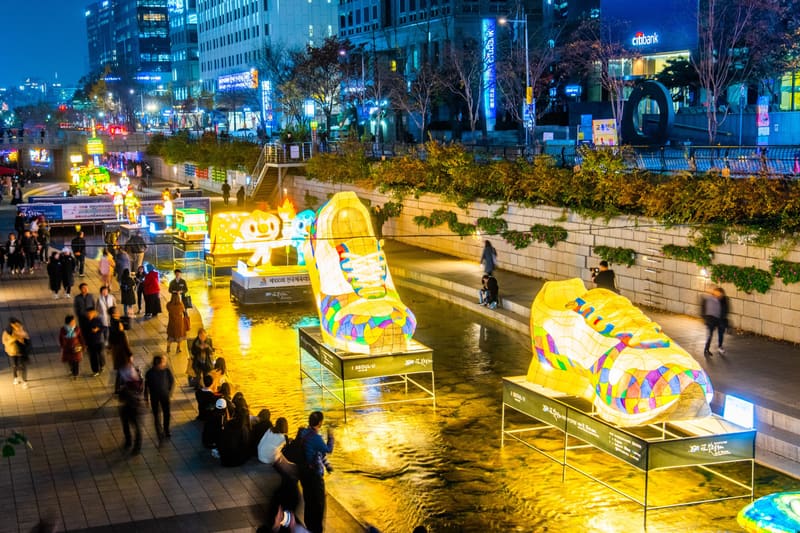
- Traditional lantern exhibitions along Cheonggyecheon and at Jogyesa and Bongeunsa (8–25 May 2026)
- Sunday street festival on Ujeongguk-ro in front of Jogyesa: about 70 groups and 129 booths in 2026 with lantern making, temple and vegan food, meditation and a craft contest for foreigners
- Eoulim Madang Buddhist rally with the Gwanbul rite at Dongguk University's main field at 14:00 before the parade
- Yeondeungnori closing performance and DJ set around Insa-dong and Gongpyeong intersection from 19:00 on Sunday
Who it suits. Best for first-time visitors to Seoul who want a large free night parade in the city centre, families, and photographers; less suited to anyone hoping to join the march on the spot (marchers take part through temples and registered groups), or who dislikes dense pavements and road closures across Jongno.
Getting there
From Seoul
Within Seoul: Subway Line 1 to Jonggak Station, Exit 2, then 300 m along the road to Jogyesa; or Line 3 to Anguk Station, Exit 6, about 300 m. For the parade, any Line 1 station on Jongno (Jongno 5-ga, Jongno 3-ga, Jonggak) puts you on the route; Dongdaemun (Lines 1 and 4) is nearest the Heunginjimun start.
From Busan
KTX from Busan to Seoul Station (about 2 h 30 m), then Subway Line 1 two stops to Jonggak.
From Incheon Airport
AREX to Seoul Station, then Line 1 to Jonggak (Exit 2); or an airport limousine bus to the Jongno/Insa-dong area.
Last leg from Jonggak Station
Seoul Subway Line 1, Exit 2. 300 m to Jogyesa; Anguk Station (Line 3) Exit 6 is also about 300 m
Getting home
The parade ends about 21:30 and the Jonggak party about 23:00, within normal subway hours; Jonggak (Line 1) and Anguk (Line 3) are a few minutes' walk from Jogyesa. Expect Jongno surface buses to be diverted while the road is closed (ten median bus-lane stops were relocated in 2026). If you are going back to Busan or another city by KTX the same night, check the last train in the Korail+ app (코레일+, where KTX and former SRT trains are now booked) or at Seoul Station before you go.
Parking
Not advised: in 2026 Jongno between Jonggak and Heunginjimun was closed from the afternoon of parade day until the early hours of Sunday, Jongno west of Jonggak and Ujeongguk-ro in the evening, and Ujeongguk-ro all day Sunday; Seoul city and the organizer recommend public transport and walking.
How to switch Naver Map and Kakao Map to English
Google Maps shows train, subway and bus routes in Korea but not walking or driving directions yet, so for the walk from the station Naver Map or Kakao Map is more reliable.
Before you go
1330 · Travel hotline
The Korea Tourism Organization’s helpline answers in English, Japanese and Chinese around the clock, and in several other languages from 08:00 to 19:00. Dial 1330 from a Korean phone, or +82-2-1330 from a phone registered abroad.
112 / 119 · Emergencies
112 for police, 119 for fire and ambulance. Both are free from any phone. Police on 112 can add an English or Chinese interpreter to the call.
T-money card
Buy one at a convenience store such as GS25, CU or 7-Eleven and top it up there with cash. It pays for subways and buses in most cities, and for most taxis.
Maps
Use Naver Map or Kakao Map for walking and bus directions; Google Maps does not yet give walking directions in Korea. Both apps can be switched to English. Naver Map: Menu (≡) → Settings → Language (Japanese and Chinese also available). Kakao Map: Menu (≡) → Settings → App settings → Language. If the option is missing, change your phone’s language and reopen the app. Small shop names and some reviews stay in Korean.
Trains and buses
Book trains on Korail’s English site and express buses on Kobus. Holiday weekends sell out first.
Checked 18 October 2026.
Tickets, prices and practical details
| Item | Price | Note |
|---|---|---|
| Watching the parade, exhibitions and street festival | Free | Free (KTO 2026 guide) |
| Hands-on activities at the street festival | — | Some booths charge a separate fee (KTO); amounts not published |
| Templestay, one day (1–31 May 2026, 35 temples) | ₩15,000 | Book at templestay.com; amount from the KTO 2026 guide, not rechecked |
| Templestay, two days one night | ₩30,000 | Book at templestay.com; amount from the KTO 2026 guide, not rechecked |
- Booking
- No ticket exists for watching. Parade marchers take part through temples and registered groups; foreign visitors who want to walk should check llf.or.kr for a participation call. Templestay programmes are booked at templestay.com.
- English on site
- llf.or.kr has an English section; the 2026 committee ran an 'LLF Friends' global supporters programme, and the street festival included a craft contest for foreigners and international Buddhist exchange booths. KTO's 1330 hotline covers English, Japanese and Chinese.
- Crowds
- More than 500,000 people over the 2026 weekend; pavements along Jongno fill well before the 19:00 start, and the Jonggak end is densest for the finale.
- Best time to go
- Arrive on Jongno by 18:00–19:00 for a kerb spot (KTO advice); the Jonggak intersection gets the finale and the post-parade party; Sunday daytime for the booths with fewer people.
- What to bring
- A small mat or folding stool for the kerb, and a light layer for a May evening outdoors.
- Rain
- The parade went ahead in rain in 2024 (Yonhap); no cancellation policy is published.
Editions
| Year | Dates | Status | Notes |
|---|---|---|---|
| 2027 | Buddha's Birthday is Thursday 13 May 2027 (KASI calendar; lunar 4/8). The parade has fallen on a Saturday four to nine days before Buddha's Birthday (11 May 2024, 26 April 2025, 16 May 2026), so expect the parade on Saturday 8 May 2027, the street festival on Sunday 9 May, and lantern exhibitions from late April to mid-May. The 2026 schedule was announced on 20 March. | expected | No 2027 schedule had been published on llf.or.kr as of 21 October 2026. |
| 2026 | 8–25 May 2026 | ended | Road closures: Jangchungdan-ro (Dongguk Univ.–Heunginjimun) 18:00–20:30 on 16 May; Jongno from Jonggak to Heunginjimun 13:00 on 16 May to 03:00 on 17 May; Jongno from Sejong-daero to Jonggak and Ujeongguk-ro (Anguk–Jonggak) 18:00–24:00 on 16 May; Ujeongguk-ro 09:00–24:00 on 17 May; ten median bus-lane stops between Jonggak and Heunginjimun relocated. |
| 2025 | 16 Apr – 6 May 2025 | ended | Start/end given here are the Cheonggyecheon exhibition window; the core weekend was 26–27 April. |
| 2024 | 11–12 May 2024 | ended | Dongdaemun–Jonggak closed on 11 May; Anguk–Jonggak closed 09:00–24:00 on 12 May |
Before or after the festival
Places you can fit in before or after the festival without missing the shuttle or the last train or bus back.
The main royal palace of the Joseon dynasty, a walled compound of throne halls, courtyards and pavilions behind Gwanghwamun Gate. On parade Saturday go late morning or early afternoon: in spring it is open 09:00–18:00 (last entry 17:00), closed Tuesdays, so leave by mid-afternoon to claim a kerb on Jongno before the 19:00 start. Adults pay ₩3,000 (a rise is planned, timing undecided). Tip: the guard-changing ceremony at the gate is at 10:00 and 14:00.
Getting there: Line 3 from Gyeongbokgung Station one stop to Anguk (Exit 6, about 300 m to Jogyesa), or about 15 minutes on foot; basic subway fare
The old-town street of galleries, craft shops and teahouses beside Jogyesa, with the spiral-walkway Ssamziegil arcade; browse or stop for traditional tea. It fits either side of the parade, and on Sunday it is central: the street festival fills Ujeongguk-ro next door, and in 2026 the closing Yeondeungnori started at 19:00 around Insa-dong and Gongpyeong intersection. Tip: the street runs down to Jongno, so the parade route is a short walk away.
Getting there: On foot: a few minutes east of Jogyesa; Anguk Station (Line 3) is at its northern end; free
A stream restored in 2005 that runs below street level through downtown Seoul, its walkways hung during the festival with one of the three traditional lantern exhibitions. Walk it after the parade or on Sunday evening: in 2026 the exhibitions were lit nightly from 8 to 25 May, and the subway is still running when the Jonggak party ends around 23:00 (lighting hours were not published). Tip: if parade night is too crowded, come back on a weekday evening.
Getting there: On foot: a few minutes south of Jonggak Station and the end of the parade route; free
Questions travelers ask
When is the Lotus Lantern Festival 2027 in Seoul?
Not announced yet. Buddha's Birthday is Thursday 13 May 2027, and the parade has been held on a Saturday four to nine days before it (16 May 2026, 26 April 2025, 11 May 2024), so expect Saturday 8 May 2027. The 2026 schedule came out on 20 March.
Is Yeon Deung Hoe free?
Yes. Watching the parade, the lantern exhibitions at Jogyesa, Cheonggyecheon and Bongeunsa, and the Sunday street festival costs nothing. Some hands-on booths charge a small fee, and templestay programmes are booked and paid for separately at templestay.com.
Can foreigners join the parade?
Possibly, through a temple or registered group: marchers take part in groups (Seoul city expected about 60 in 2026). Check llf.or.kr for a participation call after the year's schedule is announced (20 March in 2026). Watching from the pavement needs no registration.
Where is the best place to watch the parade?
Anywhere on Jongno between Heunginjimun and Jonggak; the parade runs 19:00–21:30 and the Jonggak intersection hosts the post-parade Daedong Hanmadang until 23:00 with the 'flower rain' finale. Arrive by 18:00 for a kerb spot.
What is the difference between Yeon Deung Hoe and Buddha's Birthday?
Yeon Deung Hoe is the lantern festival held in the weeks before Buddha's Birthday; the holiday itself (24 May 2026, 13 May 2027) is marked by a 10:00 ceremony at Jogyesa and temples nationwide, not by the parade.
Which roads close for the parade?
Jongno between Heunginjimun and Jonggak closes to traffic from the afternoon of parade day until the early hours of Sunday; Jongno west of Jonggak and Ujeongguk-ro close in the evening, and Ujeongguk-ro in front of Jogyesa closes all day Sunday for the street festival. Median bus-lane stops along the route are moved (ten in 2026). Seoul city publishes the year's closures a few days before the parade (14 May for the 16 May 2026 parade).
What happens besides the parade?
A lantern-lighting ceremony in Gwanghwamun Square (22 April 2026), lantern exhibitions over two to three weeks, a Buddhist rally at Dongguk University on parade afternoon, the Sunday street fair of about 129 booths in front of Jogyesa, and an evening closing show.
Is it a religious event?
It is organised by the Jogye Order of Korean Buddhism and includes rites, but the parade and street fair are open to everyone. It is a national intangible cultural heritage (2012) and on UNESCO's list (2020).
What is the weather like during Yeon Deung Hoe (Lotus Lantern Festival)?
April in Seoul: average high 18 °C (64 °F), low 8 °C (46 °F), 73 mm of rain (Seoul station, KMA 1991–2020 normals). May in Seoul: average high 24 °C (74 °F), low 14 °C (56 °F), 104 mm of rain (Seoul station, KMA 1991–2020 normals). Mild days, cold evenings: a jacket for after dark.
Sources and verification
Facts checked
21 October 2026, against the sources listed below.
This page is desk research from the sources below, not a firsthand report of the 2027 edition. Confidence in the current facts: high.
- Korea Tourism Organization — Guide to 2026 Yeon Deung Hoekto — Seoul 8–25 May 2026, opening lanterns 8 May at Jogyesa/Bongeunsa/Cheonggyecheon, parade Sat 16 May Heunginjimun–Jongno–Jogyesa with 100,000+ lanterns, advance registration to march, free admission with some paid hands-on, arrive 18:00–19:00, road closures, templestay ₩15,000/₩30,000, Buddha's Birthday 24 May 2026
- Yeon Deung Hoe — official site (llf.or.kr)official — Event structure (lighting ceremony, exhibitions, Eoulim Madang, parade, Hoehyang/Daedong Hanmadang, traditional culture madang, Yeondeungnori, performances, Buddha's Birthday ceremony)
- Yeon Deung Hoe — official English pageofficial — English event descriptions (Eoulim Madang with Gwanbul rite, Daedong Hanmadang, Yeondeungnori)
- Seoul Metropolitan Government Media Hub — 2026 parade traffic notice (14 May 2026)municipal — Parade 16 May 19:00–21:30 from Dongguk University via Heunginjimun and Jongno to Jogyesa; detailed road-closure times; Daedong Hanmadang 21:30–23:00 with flower rain; 17 May street festival; ten bus stops relocated; about 60 groups and 20,000+ citizens expected to march
- Newsis — '로봇 스님과 10만 연등 물결' (16–17 May 2026)news — Rally at Dongguk University 14:00, parade 19:00, about 50,000 marchers and 100,000 lanterns, over 500,000 attendance, robot monks, Norazo at Jonggak, 17 May street fair with 70 groups/129 booths, Yeondeungnori 19:00 at Insa-dong/Gongpyeong, slogan
- Yonhap via fnnews — 2026 Yeon Deung Hoe schedule announced (20 Mar 2026)news — Lighting ceremony 22 April at Gwanghwamun, exhibitions 8–25 May, parade 16 May 19:00, street festival and Yeondeungnori 17 May, Buddha's Birthday ceremony 24 May 10:00, LLF Friends programme, announcement date
- Seoul Media Hub — 2025 Yeon Deung Hoe (2 May 2025)municipal — 2025 Cheonggyecheon exhibition 16 Apr–6 May, parade 26–27 Apr, Daedong Hanmadang and Yeondeungnori, UNESCO 2020
- YTN — 2025 parade preview (25 Apr 2025)news — 2025 parade 26 April 19:00–21:30 Heunginjimun–Jonggak–Jogyesa; Daedong Hanmadang 21:30; Buddha's Birthday 5 May 2025
- Yonhap via Daum — 2024 parade report (11 May 2024)news — 2024 parade 11 May in rain, about 50,000 marchers, route, Dongguk University rally, 12 May fair 11:00–18:00 and evening events, road closures, Buddha's Birthday 15 May 2024, heritage designations 2012/2020
- Jogyesa — Location (English)official — Address 55 Ujeongguk-ro; Jonggak Station Line 1 Exit 2 (300 m); Anguk Station Line 3 Exit 6; bus stops
- KASI — 2027 calendar dataother — Buddha's Birthday 2027 = Thursday 13 May (lunar 4/8)
- dallyeok.com — Buddha's Birthday 2027other — Cross-check: 13 May 2027 (Thu); 24 May 2026, 5 May 2025, 15 May 2024
- Wikipedia — Jogyesaother — Coordinates 37.5739, 126.9819
- ktriptips (KTO data mirror) — 경복궁 (contentId 126508)kto — Gyeongbokgung hours: March–May 09:00–18:00 (last entry 17:00); closed Tuesdays; adult ₩3,000 (read for this site's Gyeongbokgung Starlight Tour record on 22 Oct 2026; not reopened for this edit)
- Namane Card blog — 궁궐 입장료 인상 보류 (10 Oct 2026, citing the Korea Times of 8 Oct 2026)blog — Palace fee rise planned but its timing undecided at the 8 Oct 2026 audit; ₩3,000 still applies (cited from this site's Gyeongbokgung guard-ceremony record)
- Seoul Hanok portal (Seoul Metropolitan Government) — Insa-dong: A Living Museummunicipal — Insa-dong: galleries since the Hyundai Gallery (1970), traditional craft shops, restaurants and teahouses in the alleys; Ssamziegil, opened 2004, a four-storey building with a spiral hallway
- Seoul Metropolitan Facilities Management Corporation — Cheonggyecheon (English)municipal — Cheonggyecheon restoration began July 2003 and was completed on 1 October 2005; restored stretch from Gwanghwamun (Dong-A Ilbo building) eastwards; walkways, decks and stepping-stones
What we could not confirm
- Official 2027 schedule and the exact parade date (expected 8 May 2027)
- Whether and how foreign visitors can join the Seoul parade: llf.or.kr shows no participation form or deadline, and the KTO guide could not be rechecked in the 21 October 2026 audit.
- Templestay prices for May 2026 (₩15,000 one day, ₩30,000 overnight) come only from the KTO guide; recheck in a browser or on templestay.com.
- Fees for individual hands-on booths at the street festival
- 2024 and 2025 full exhibition date ranges; 2026 street-festival hours
- No Wikimedia Commons photo could be verified (Commons category/file pages were unreachable during research)
- 2027 road closures and bus diversions on parade day (Seoul city usually publishes them a few days before), and 2027 lighting hours of the Cheonggyecheon lantern exhibition.
Changes: 2026-10-16 — Full fact-first rewrite: hours, prices, stations, 2024–2027 editions, FAQs and sources. · 2026-10-16 — Rechecked against timetables, fare tables and organizer notices: conflicting dates and transport details. · 2026-10-18 — Added a photograph from the Korea Tourism Organization (Korea Tourism Content Lab), KOGL Type 1. · 2026-10-21 — Corrected after an independent fact audit: parade participation now described as through temples and registered groups (the registration-form and Jeonju claims were unsupported); templestay prices removed from the FAQ and booking note; 2026 marcher count attributed (Newsis about 50,000; Seoul city expected 20,000+). · 2026-10-31 — Nearby rewritten as 'Before or after the festival' (shuttle and last-train fit); transport: 2026 road-closure clock times removed from the road-closure FAQ and parking note (pattern kept); the last-train note now says to check the KTX in the Korail+ app; prices: none changed (watching is free and no fees are quoted).