At a glance
| Dates | Expected Mar 2027Early-to-mid March 2027 (26th edition), ten days around peak bloom, following 7–16 Mar 2025 and 13–22 Mar 2026. The committee met on 4 February 2026 and the city announced the 2026 dates on 5 February, so expect a February 2027 announcement. |
|---|---|
| Next edition | 2027: Early-to-mid March 2027 (26th edition), ten days around peak bloom, following 7–16 Mar 2025 and 13–22 Mar 2026. The committee met on 4 February 2026 and the city announced the 2026 dates on 5 February, so expect a February 2027 announcement. |
| Weather | March average 14/1 °C (58/33 °F), 78 mm of rainNear or below freezing after dark: a warm coat and layers. Monthly averages, not a forecast: Korea Meteorological Administration climate normals, 1991–2020, Jinju station, about 30 km away. |
| Admission | Paid: about ₩5,000–6,000 for adults and a little less for teenagers, refunded in full at the gate as Gwangyang local gift vouchers to spend at festival stalls and nearby shops; the village is free outside the ten festival days.Adult admission: ₩6,000 · Teenager admission: ₩5,000 · Free entry (per visitor blog, unverified): Free (2026 prices) |
| Venue | Gwangyang Maehwa Village (Seomjin Village) and Hong Ssang-ri Cheongmaesil Farm전라남도 광양시 다압면 지막1길 55 |
| Nearest station | Suncheon Station (순천역), KTX Jeolla Line from Yongsan (Gwangyang Station on the Gyeongjeon Line is closer but not on the KTX network)Not walkable: about 40 minutes' drive from Suncheon to the village (visitor report); continue by bus via Gwangyang Terminal (bus 15 to Seomjin stop, only a few a day) or taxi |
| From Seoul | Not published · KTX + BusLeave from Yongsan Station · One-way fare from ₩42,300Full route · Festivals by travel time from Seoul |
| Organizer | Gwangyang Maehwa Festival Committee (hosted by Gwangyang City)광양매화축제위원회 (주최 광양시) |
| Usual timing | Ten days in the first three weeks of March, timed to the plum blossom (2024: 8–17 Mar; 2025: 7–16 Mar; 2026: 13–22 Mar). The festival committee fixes the dates in early February; the 2026 dates were announced on 5 February 2026. Browse March festivals. |
| First held | 1995 |
| Last checked | 21 October 2026Checked against 18 sources · See sources |
Bloom forecast: Flower festivals set or move their dates by the bloom forecast, so this window can shift by a week or two. Check again a few weeks before you go.
What it is like
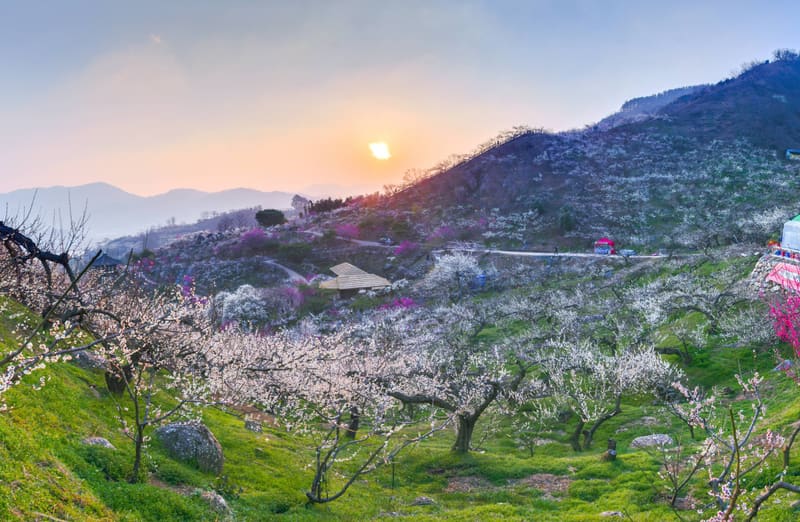
Maehwa Village, also called Seomjin Village, sits on a slope above the Seomjin River in Daap-myeon, on the border between Jeollanam-do and Gyeongsangnam-do. Hong Ssang-ri began planting plum trees here in 1966, on slopes her father-in-law Kim O-cheon had started cultivating, and built Cheongmaesil Farm, famous for its plum products and the thousands of onggi jars standing among the trees (some 2,000–3,000, by different accounts). The farm started a blossom festival in 1995 with 3,000 visitors; the city took it over in 1997, and it now draws hundreds of thousands of visitors each spring (about 840,000 over March 2026) to orchards covering 198,000 m². The festival is a walk: paths climb through the white and pink trees to viewpoints over the river, with a culture centre showing folk painting and media art, a stamp tour, photo studio, plum-blossom archery, a plum highball tasting, and a food street run by village residents with price checks. Since 2024 entry has cost a few thousand won, returned in full as vouchers spent on site. The caveats are real: the bloom depends on the weather (2025 was a poor year), the grounds are car-free so you walk or take a shuttle from the main lot, and the two weekends are extremely crowded, with 130,000 people on Saturday 21 March 2026 and long traffic jams on the single road into the village. Weekday mornings are the way to see it.
Highlights
- 198,000 m² of plum blossom on the Seomjin riverside slopes, with viewpoints over the river and Hadong on the far bank
- Hong Ssang-ri Cheongmaesil Farm: some 2,000–3,000 traditional onggi jars among the trees and plum products for sale (open 08:00–17:00)
- Maehwa Culture Center special exhibition: minhwa by Eom Jae-kwon and works by eight media artists (2026)
- Stamp tour, Maehwa life photo studio, plum-blossom archery and plum highball experience
- Village food street with 12 resident vendors: Gwangyang bulgogi dosirak, bulgogi gimbap, plum hanwoo burger, charcoal chicken skewers
- Fun Run from Dunchi parking lot and a pre-booked two-night camping programme at Geumcheon Valley (2026)
Who it suits. Best for walkers, photographers and day-trippers combining Suncheon or Yeosu; less suited to visitors with limited mobility or tight schedules, because the orchard paths are steep, the grounds are car-free and weekend traffic on the approach road is severe.
Getting there
From Seoul
KTX from Yongsan Station to Suncheon Station (usually 2 h 25 m–2 h 50 m, a few slower services up to 3 h 27 m; ₩42,300; about 18 KTX a day as listed in October 2026), then on to Gwangyang Bus Terminal and city bus 15 to the Seomjin (섬진) stop, a 2-minute walk from the festival entrance. Bus 15 runs only a few times a day (about three, per a 2025 visitor report), so check departure and return times at Gwangyang Terminal or plan on a taxi. By road the village is about 40 minutes' drive from Suncheon (visitor report). Trains also reach Gwangyang Station on the Gyeongjeon Line, from where bus 2 goes to the terminal. One visitor paid about ₩28,000 by taxi to the village and about ₩42,000 back to Gurye station (2025).
From Busan
Approach from the east via Hadong (Gyeongsangnam-do), across the river from the village: city bus 35-1 from Hadong Bus Terminal stops at Seomjin, a 2-minute walk from the venue. Busan–Hadong timings were not established.
Last leg from Suncheon Station
KTX Jeolla Line from Yongsan (Gwangyang Station on the Gyeongjeon Line is closer but not on the KTX network). Not walkable: about 40 minutes' drive from Suncheon to the village (visitor report); continue by bus via Gwangyang Terminal (bus 15 to Seomjin stop, only a few a day) or taxi
Festival shuttle
2026 (Seoul Shinmun; the city's festival page links a free-shuttle and parking notice): more shuttles between Dunchi parking lot and the grounds, and a new downtown shuttle (Gwangyang-eup – Jungma-dong – festival) six times a day at weekends. Per a visitor guide that could not be rechecked: the Dunchi shuttle covered 1.5 km and ran every day from early morning into the evening; a Sodunchi lot (3 km) shuttle ran on the two weekends only; the downtown shuttle left Gwangyang Terminal via the tourist information centre in the morning, cost about ₩5,000 return and was booked in the MY광양 app with a bank transfer by the day before. Times change each year: check the city's shuttle notice for this edition.
Getting home
KTX trains run from Suncheon to Yongsan (usually 2 h 25 m–2 h 50 m); the timetable for the 2027 festival dates has not been checked, so check the last train in the Korail+ app (코레일+) or at the station before the festival day. The 2026 downtown shuttle ran at weekends only; otherwise take bus 15 to Gwangyang Terminal (only a few a day, so check the last one) or bus 35-1 to Hadong, or a taxi (drivers from the village may only agree to go to Gurye).
Parking
In 2026 the city added 250 parking spaces (Seoul Shinmun). Per a visitor guide that could not be rechecked (check the city's parking notice for 2027): Dunchi lot (about 2,200 cars, free; navigate to '신원리 둔치주차장'), Sodunchi lot (about 700, free, weekend shuttle only), Dosa lot for coaches and RVs (free) and a small paid Seomjingang lot by the grounds. Arrive before 09:00 on weekends; the approach road jams badly.
How to switch Naver Map and Kakao Map to English
Google Maps shows train, subway and bus routes in Korea but not walking or driving directions yet, so for the walk from the station Naver Map or Kakao Map is more reliable.
Before you go
1330 · Travel hotline
The Korea Tourism Organization’s helpline answers in English, Japanese and Chinese around the clock, and in several other languages from 08:00 to 19:00. Dial 1330 from a Korean phone, or +82-2-1330 from a phone registered abroad.
112 / 119 · Emergencies
112 for police, 119 for fire and ambulance. Both are free from any phone. Police on 112 can add an English or Chinese interpreter to the call.
T-money card
Buy one at a convenience store such as GS25, CU or 7-Eleven and top it up there with cash. It pays for subways and buses in most cities, and for most taxis.
Maps
Use Naver Map or Kakao Map for walking and bus directions; Google Maps does not yet give walking directions in Korea. Both apps can be switched to English. Naver Map: Menu (≡) → Settings → Language (Japanese and Chinese also available). Kakao Map: Menu (≡) → Settings → App settings → Language. If the option is missing, change your phone’s language and reopen the app. Small shop names and some reviews stay in Korean.
Trains and buses
Book trains on Korail’s English site and express buses on Kobus. Holiday weekends sell out first.
Checked 18 October 2026.
Tickets, prices and practical details
| Item | Price | Note |
|---|---|---|
| Adult admission | ₩6,000 | Refunded in full as Gwangyang local gift vouchers usable at festival stalls, Daap-myeon shops, Jungma Market and the seafood distribution centre |
| Teenager admission | ₩5,000 | Refunded in full as vouchers |
| Free entry (per visitor blog, unverified) | Free | Children 6 and under, seniors 65+, Gwangyang residents under 19, registered disabled, persons of national merit |
| Downtown weekend shuttle, return (per visitor blog, unverified) | ₩5,000 | Gwangyang Terminal–tourist information centre–Maehwa Village; booked in the MY광양 app |
| Dunchi and Sodunchi parking lots (per visitor blog, unverified) | Free | Small Seomjingang lot next to the grounds is paid |
- Booking
- No booking for entry; tickets are sold at the gate. In 2026 the weekend downtown shuttle was reserved in the MY광양 app with a bank transfer (per a visitor guide), and the two-night camping programme needed advance reservation.
- English on site
- KTO has an English page on Maehwa Village itself (not the festival); the city's festival pages and the MY광양 app used for shuttle booking are in Korean only.
- Crowds
- Extremely crowded on both weekends (130,000 on Saturday 21 March 2026); mid-week days in the middle of the run are the quietest.
- Best time to go
- Weekday mornings in the middle of the ten days. A visitor blog reported the 2026 bloom at about 40% on 9 March, 70–80% on 13 March, full from about 15 March and dropping after 20 March, and says the city posts bloom rates and road CCTV links on its site.
- What to bring
- Warm layers (mornings are cold), walking shoes for the orchard paths, cash (Cheongmaesil Farm does not take cards, per KTO), and the paper vouchers you receive at the gate.
- Step-free access
- The orchard is on a hillside with climbing paths, and the car-free rule means a shuttle or a walk from the main lot (about 1.5 km, per a visitor guide); no step-free route is published.
Editions
| Year | Dates | Status | Notes |
|---|---|---|---|
| 2027 | Early-to-mid March 2027 (26th edition), ten days around peak bloom, following 7–16 Mar 2025 and 13–22 Mar 2026. The committee met on 4 February 2026 and the city announced the 2026 dates on 5 February, so expect a February 2027 announcement. | expected | |
| 2026 | 13–22 Mar 2026 | ended | Car-free festival grounds; 250 more parking spaces than 2025; extra shuttles between Dunchi lot and the venue; new downtown shuttle six times a day on weekends |
| 2025 | 7–16 Mar 2025 | ended | On-site shuttle expanded to two routes |
| 2024 | 8–17 Mar 2024 | ended | 23rd edition. About 850,000 visitors during the bloom period per the city at the time (a 2026 report gives 500,000 for the 2024 festival); traffic jams on the way into the village remained unresolved (city statement). |
Before or after the festival
Places you can fit in before or after the festival without missing the shuttle or the last train or bus back.
- Getting awayAfter
Getting away is the hard part: the grounds are car-free, the approach road jams at weekends and bus 15 to Gwangyang Terminal runs only a few times a day, so check its last departure when you arrive. Taxi drivers at the village may only agree to go to Gurye; a visitor paid about ₩42,000 to Gurye's station. Check the last train in the Korail+ app (코레일+) before you go.
Questions travelers ask
When is the Gwangyang Maehwa Festival 2027?
Not yet announced; expect early-to-mid March 2027 for ten days. The 2026 edition ran 13–22 March and the 2025 edition 7–16 March, with dates fixed by the committee in early February.
Does the Gwangyang Maehwa Festival cost money?
Yes, entry is paid: about ₩5,000–6,000 for adults and a little less for teenagers, refunded in full as local gift vouchers to spend at festival stalls, Daap-myeon shops or Jungma Market. Outside festival dates the village is free.
How do I get to Maehwa Village by public transport?
KTX from Yongsan to Suncheon (usually 2 h 25 m–2 h 50 m, ₩42,300), then to Gwangyang Bus Terminal and city bus 15 to the Seomjin stop; bus 15 runs only a few times a day (about three, per a 2025 visitor report), so check times at the terminal or plan on a taxi. From Hadong, bus 35-1 also stops at Seomjin. On festival weekends the city has also run a booked downtown shuttle for a small fee (per a visitor guide); check this edition's notice.
When do the plum blossoms peak in Gwangyang?
Usually mid-March. A visitor blog reported the 2026 bloom at about 40% on 9 March, 70–80% by the 13 March opening and full from about 15 March, with petals falling after 20 March. 2025 was a poor bloom year.
Is there parking at the Gwangyang Maehwa Festival?
Yes, but the grounds are car-free. In 2026 the city added 250 spaces and more shuttles from the Dunchi lot to the grounds. A visitor guide put Dunchi at about 2,200 cars (free, shuttle every day) and Sodunchi at about 700 (weekend shuttle only); check the city's parking notice. Lots and the approach road fill early, so arrive before 09:00 on weekends.
How crowded is the Gwangyang Maehwa Festival?
Very, on weekends: more than 130,000 people came on Saturday 21 March 2026 and about 710,000 over the ten days. Mid-week days are far quieter.
What is Cheongmaesil Farm?
The plum farm at the heart of the village, founded by Hong Ssang-ri, Korea's Traditional Food Master No. 14, who began planting plum trees here in 1966 on slopes her father-in-law, Kim O-cheon, had started cultivating. Thousands of onggi jars (some 2,000–3,000, by different accounts) stand among the trees; it opens 08:00–17:00.
What is the weather like at Gwangyang Maehwa Festival in March?
March in Gwangyang: average high 14 °C (58 °F), low 1 °C (33 °F), 78 mm of rain (Jinju station, about 30 km away, KMA 1991–2020 normals). Near or below freezing after dark: a warm coat and layers.
Sources and verification
Facts checked
21 October 2026, against the sources listed below.
This page is desk research from the sources below, not a firsthand report of the 2027 edition. Confidence in the current facts: high.
- Gwangyang City tourism — 제25회 광양매화축제municipal — 2026 dates 13–22 Mar, venue Daap-myeon Maehwa Village, organizer 광양매화축제위원회, contact 061-797-2721; links a '무료 셔틀버스 운영 및 주차장 안내' notice (details not checked); gives no opening hours
- Gwangyang City tourism — festival listmunicipal — Festival listing and link to the 2026 festival page
- KTO VisitKorea — Gwangyang Maehwa Villagekto — English page on Maehwa Village: open 24 hours, phone, parking; now gives the province as Jeonnam-Gwangju Special Metropolitan City
- ktriptips (KTO TourAPI mirror) — 홍쌍리 청매실농원map — Coordinates 35.0755, 127.7167; address 지막1길 55 (now listed under 전남광주통합특별시); farm hours 08:00–17:00; credit cards not accepted (신용카드 불가)
- Seoul Shinmun — 제25회 광양매화축제 3월 13일 개막, 입장료 지역상품권 환급 (5 Feb 2026)news — Announcement date, committee meeting 4 Feb, ₩6,000 adults / ₩5,000 teenagers (up ₩1,000), voucher use, programmes, more Dunchi shuttles, new downtown shuttle 광양읍~중마동~축제장 six times a day at weekends, parking +250
- Money Today — 한반도 봄의 전령사 광양매화축제 (5 Mar 2026)news — '한반도 봄의 전령사' (herald of spring), 198,000 m² orchard, ₩6,000/₩5,000 entry, history (1966 trees, 1995 first festival, 1997 city takeover), programmes, free-entry partners
- Seoul Shinmun — 하루 13만명, 이달에만 84만명 (23 Mar 2026)news — 2026 visitor totals, 2024 (500,000) and 2025 comparison figures
- Seoul Shinmun — 제24회 광양매화축제 오늘 개막 (7 Mar 2025)news — 2025 dates 7–16 Mar, programmes, voucher refund, shuttles
- Seoul Shinmun — 85만명 찾은 제23회 광양매화축제 폐막 (18 Mar 2024)news — 2024 dates 8–17 Mar, about 850,000 visitors (누적 방문객), first paid year, 150,000 paying visitors, ₩750 million, traffic problems
- dnublog — 2026 광양매화축제 완벽 가이드 (visitor blog)blog — Shuttle routes/times/fares, parking lot sizes, ticket-office hours, free-entry categories, bloom timeline, committee phone; the page returned a server error on 21 Oct 2026, so these figures could not be rechecked
- Telltrip — 광양 매화마을 (travel article)blog — Bus 15/35 from Gwangyang Terminal and 35-1 from Hadong to Seomjin stop; 2,000 onggi jars; Hong Ssang-ri
- There She Goes Again — Gwangyang Maehwa Festival (blog)blog — Bus 2 Gwangyang Station–terminal, bus 15 only about three times a day and bus 35 reported discontinued (2025), taxi about ₩28,000 to the village and ₩42,000 back to Gurye station, about 40 minutes' drive (start not stated), Gurye taxi tip
- Gwangju News — Whisper of Spring (March 2025)blog — Visit early/weekday tip, layers, Suncheon Bay and Yeosu as add-ons
- train.asamaru.net — 용산역→순천역 timetableother — 25 trains a day, 18 of them KTX/KTX-Sancheon (timetable read 21 Oct 2026); KTX 2 h 24 m (KTX-Sancheon 531) to 3 h 27 m (541); ₩42,300 fare
- train.asamaru.net — 순천역→용산역 timetableother — Last departures 19:46, 20:44, 22:15
- 무등일보 via Daum — 광양 매화마을 현장 (2026-03-10)news — The orchard was started by Yulsan Kim O-cheon; his daughter-in-law Hong Ssang-ri took plum farming further
- Bravo My Life (etoday) — 홍쌍리 명인 (2022-04-01)news — Hong began planting plum trees in 1966, the year after she married into the family; 3,000 jangdokdae jars (3000개의 장독대)
- Seoul Shinmun — 69억 투자 광양 짚와이어, 7개월 만에 ‘적자난’으로 중단 위기 (22 Jul 2025)news — Gwangyang zip wire (Seomjin Star Sky) runs 898 m from Mangdeok-san at Mangdeok port to the Baealdo waterfront; facing suspension over losses (basis for dropping it from nearby)
What we could not confirm
- Two KTO-derived records (the farm's TourAPI record and the KTO village page) now give the province as '전남광주통합특별시' (Jeonnam-Gwangju Special Metropolitan City); the record keeps Jeollanam-do until the change is confirmed in law.
- Suncheon–Gwangyang bus times and fares, the current bus 15 timetable from Gwangyang Terminal (a 2025 visitor saw about three a day), Busan–Hadong connections, and a door-to-door ride time from Seoul.
- Whether gate ticketing accepts foreign cards and whether the refund vouchers can be used by visitors without a Korean ID.
- Official festival hours: the city page gives none, and the KTO festival listing once cited (vcontsId=188501) now shows another festival; only a visitor blog reports ticket-office hours.
- 2024 and 2025 per-person admission (2025 derived, 2024 unknown).
- Free-entry categories, shuttle times and fares, parking-lot sizes and the bloom percentages come from a visitor blog (unreachable on 21 Oct 2026), not an opened official page; the city's '무료 셔틀버스 운영 및 주차장 안내' notice has not been checked.
- Last KTX from Suncheon to Yongsan on the festival dates under the timetable in force that day.
- Nearby left empty: no place was found that fits before or after the festival by public transport without a car or a separate half-day (Suncheon Bay and Yeosu need a separate trip; the Seomjin Star Skyline zip line is at Mangdeok port near the river mouth, not by the village, and was reported in July 2025 to face suspension; Baegunsan forest needs a car).
Changes: 2026-10-16 — Full fact-first rewrite: hours, prices, stations, 2024–2027 editions, FAQs and sources. · 2026-10-16 — Rechecked against timetables, fare tables and organizer notices: conflicting figures and claims. · 2026-10-18 — Added a photograph from the Korea Tourism Organization (Korea Tourism Content Lab), KOGL Type 1. · 2026-10-20 — Visitor figure corrected to match the record: hundreds of thousands each spring (about 840,000 in March 2026), not over a million. · 2026-10-21 — Corrected after an independent fact audit: hours no longer credited to KTO (the cited listing now shows another festival); shuttle, parking and bloom figures labelled as from a visitor blog; bus 15 warning added and ride time removed; KTX count and times, taxi fares, onggi count, 2024 visitors and the 'first festival' claim corrected; farm takes no cards. · 2026-10-21 — Transport: removed last-KTX clock times from the October 2026 timetable, which does not cover March 2027; journey time and train count kept, with a reminder to check the last train in the Korail+ app. · 2026-10-30 — Nearby rewritten as 'Before or after the festival' (shuttle and last-train fit): no place fits by public transport, so the list is empty and a 'leaving' note was added; transport: removed the 2026 shuttle clock times and dates; prices: admission given as about ₩5,000–6,000 for adults (refunded as vouchers) without a year in the answer, admission and FAQs.